I Can't Take the Anxiety Anymore": What to Do When Everything Feels Like Too Much
There are moments when your heart races for no obvious reason, your thoughts spiral out of control, and it feels like the ground is shifting beneath your feet — even when you’re standing completely still. Maybe you’ve been carrying that sense of dread for days, or months: the feeling that something bad is just around the corner, even though you can’t quite name what it is. If you’ve ever thought “I just can’t handle the anxiety anymore,” I want you to know something before you keep reading: you’re not exaggerating, you’re not losing your mind, and you don’t have to keep feeling this way.
This article is for you — whether you’re a parent lying awake at 3 a.m. running through worst-case scenarios, someone new to Mexico City feeling unmoored and overwhelmed, or a person who feels like their own body is playing tricks on them. We’re going to talk about what’s actually happening, what you can do today, and how the right support can genuinely change things.
What Happens in Your Body and Mind When Anxiety Takes Over
Anxiety isn’t a character flaw or a sign of weakness. It’s a biological response — your nervous system doing exactly what it was designed to do when it senses danger. The problem is that for many people, that alarm system gets stuck in the “on” position, even when there’s no actual threat in sight.
When anxiety overwhelms you, you might notice:
- Physical symptoms: racing heart, muscle tension, headaches, nausea, shortness of breath, dizziness, or sweaty palms.
- Mental symptoms: spiraling thoughts, catastrophic thinking (“everything is going to fall apart”), difficulty concentrating or making even simple decisions.
- Behavioral symptoms: avoiding situations, withdrawing from people, procrastinating — or swinging the other way and staying constantly busy so you don’t have to feel it.
What you feel in your body is real. Your nervous system doesn’t distinguish between an actual threat and an imagined one — it reacts the same way to both. That’s why just telling yourself to “calm down” rarely works. Your body needs concrete signals that it’s safe.
Immediate Tools for When Anxiety Hits Hard
Before we get into deeper work, here are a few techniques you can use right now when you feel like everything is too much:
1. 4-7-8 Breathing
Inhale for 4 counts, hold for 7, exhale slowly for 8. Repeat three times. This activates your parasympathetic nervous system — the part that tells your body: “you can stand down now.”
2. The 5-4-3-2-1 Grounding Technique
Name — out loud or in your head — 5 things you can see, 4 you can touch, 3 you can hear, 2 you can smell, 1 you can taste. This anchors your mind to the present moment and interrupts the spiral.
3. Intentional Movement
Anxiety lives in the body. Moving helps discharge the built-up tension. A 10-minute walk around Condesa, shaking out your hands, rolling your shoulders — any deliberate movement sends regulating signals to your brain.
These tools are genuinely helpful in a crisis, but they’re not a substitute for a real therapeutic process. Think of them like a bandage — they help in the moment, but they don’t heal the underlying wound.
Why Anxiety Isn’t Actually Your Enemy (Even When It Feels Like One)
I know that’s hard to believe when you’re in the middle of a panic attack, but anxiety has a purpose: it’s trying to protect you. It evolved to keep you alert in genuinely dangerous situations. The issue isn’t that it exists — it’s that somewhere along the way, it learned to fire at the wrong moments, or far too often.
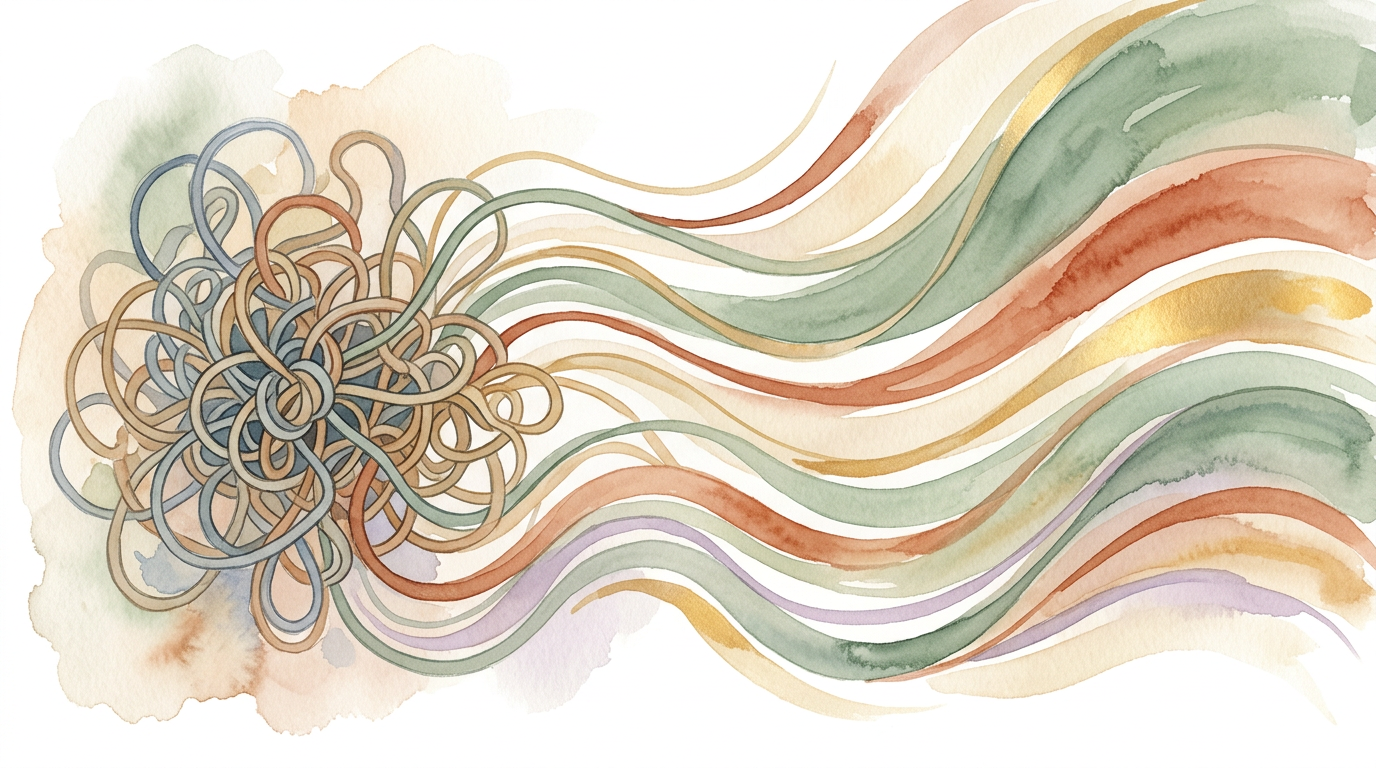
In narrative therapy, I invite people to relate to anxiety differently. Instead of seeing it as something that “has you” or something you simply are, we start to see it as something separate from you — a very loud, well-meaning voice that sometimes goes way overboard.
When we start asking anxiety questions — What are you trying to protect me from? What story are you telling me right now? — we start to have more agency over it. And that shift changes everything.
How Narrative Therapy Works With Anxiety
My practice is grounded in narrative therapy, an approach built on one core idea: the person is not the problem — the problem is the problem. That means you are not “an anxious person.” You are a person who is having a difficult relationship with anxiety.
That distinction might sound small, but it’s enormous in practice. When you stop fusing your identity with the problem, you reclaim space to respond differently.
In sessions, we work on things like:
- Externalizing anxiety: giving it a name, describing it, understanding when it first showed up in your life and what story brought it there.
- Finding exceptions: Were there times when anxiety was present but didn’t win? What did you do differently? Those moments are incredibly valuable in therapy.
- Rewriting the narrative: building an alternative story — one where you’re not anxiety’s victim, but someone who has learned to relate to it on their own terms.
This approach doesn’t aim to eliminate anxiety (that would be both impossible and counterproductive). The goal is to help it stop running your life.
I also integrate tools from cognitive-behavioral therapy and mindfulness, and I work with children using play therapy — because every person needs a path that fits them specifically.
I offer sessions in English for expats, digital nomads, and English speakers living in Mexico City. You don’t have to navigate this in your second language.
The First Step: Asking for Help Is Not Weakness
We live in a culture — across many cultures, honestly — that prizes toughness and endurance. “Push through it,” “everyone has problems,” “you’re being too sensitive.” How many times have you heard that, or said it to yourself? And yet, asking for help is one of the most courageous things you can do.
Reaching out for professional support when you can’t take the anxiety anymore doesn’t mean you failed. It means you care enough about yourself to stop carrying something alone that actually has a way through.
If you’ve been thinking about starting therapy but aren’t sure where to begin, you’re welcome to reach out via WhatsApp to schedule a first session. No pressure, no commitment — just a conversation to see if we might be a good fit.
Closing Thought: Your Story Doesn’t End Here
Anxiety can feel like a wall you can’t get around, a noise that won’t stop, a weight pressing down on your chest. But it’s also something that can be worked with, understood, and — gradually — managed.
You don’t have to wait until you’re in crisis to ask for help. You don’t need to prove that what you’re feeling is “bad enough.” If something in this article resonated with you, that’s already reason enough.
You deserve to feel okay. You deserve rest. And you don’t have to figure this out alone.

Narrative therapist in Condesa, CDMX. Graduate of Universidad Iberoamericana with two master's degrees. Professional license 14444809.
Did this article resonate with you?
If something you read connects with you, I'm here to walk alongside you. Take the first step.
Message me on WhatsAppValidated assessments and practical exercises to support your mental health.